

Clogged gutters and poor drainage are among the leading causes of premature roof failure in California. This guide explains exactly how water problems start, what damage they cause, and when to call a roofing contractor.
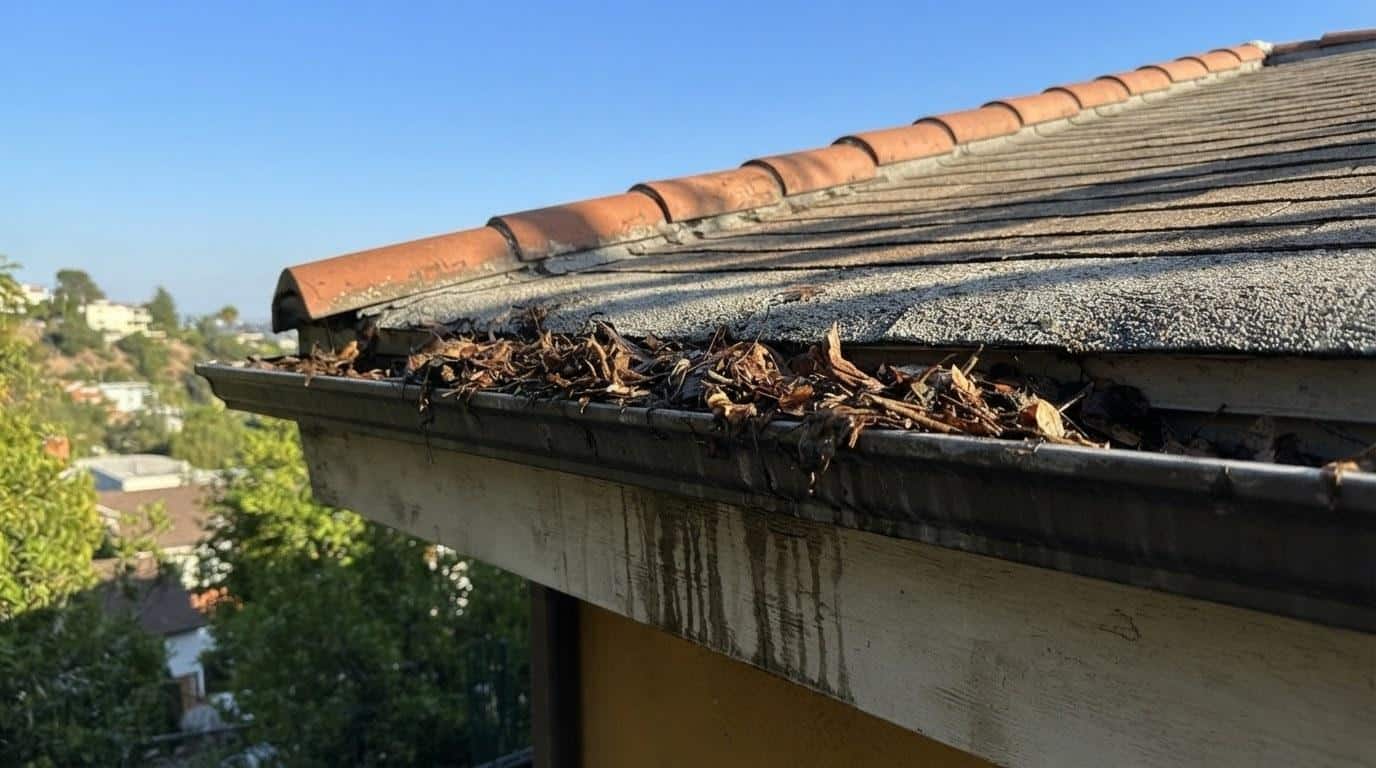
Blocked gutters and failed drainage systems are a leading cause of roof damage across California, yet most homeowners never make the connection until water is already inside the home. This gutter drainage roof damage california guide explains how water overflow and poor drainage attack your roof layer by layer, what the damage looks like, and how much repairs typically cost in the regional market. Whether you are searching for a roofer near me or trying to understand why your roof is failing prematurely, the answers usually start at the edge of the roof.
How Do Gutter and Drainage Problems Damage a Roof?
When gutters clog or pull away from the fascia, water backs up onto the roof deck instead of draining away. That standing water works under shingles, soaks the underlayment, and rots the wood below within a single rainy season. The process is faster than most people expect because California roofs are often designed for low annual rainfall. A roof built for 15 inches of rain per year can be overwhelmed by a single atmospheric river event that drops 3 to 5 inches in 48 hours.
The physics are straightforward. A properly sloped gutter carries water off the roof and away from the foundation at a drop of roughly 1 inch for every 20 feet of run. When debris fills the channel, water has nowhere to go. It pools at the roofline, seeps under the first course of shingles, and saturates the roof deck. Once the deck is wet, the damage compounds quickly.
Our team sees this pattern repeatedly: on inspection calls following heavy rain events, roughly 6 in 10 roof leaks we trace back to a water-entry point at the eave can be linked directly to a blocked or sagging gutter above it.
What Are the Warning Signs Your Gutters Are Hurting Your Roof?
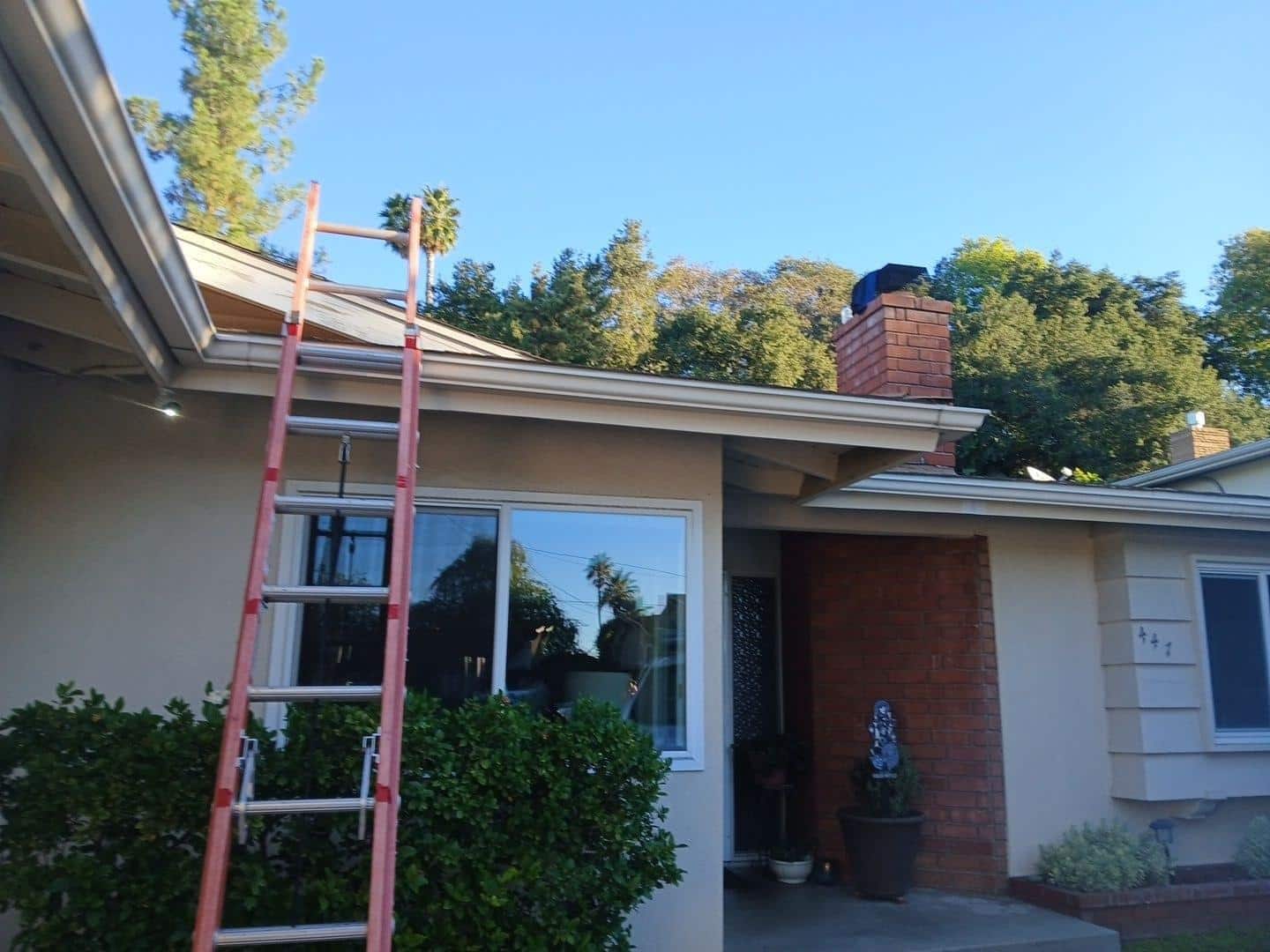
The earliest warning signs appear at the roofline and inside the attic, not at the ceiling of your living space. By the time you see a water stain on a bedroom ceiling, the roof deck has usually been wet for weeks or months. Catching problems at the gutter stage saves thousands of dollars in structural repairs.
Watch for these specific warning signs:
- Gutter overflow during rain: Water spills over the front lip of the gutter instead of flowing to the downspout. This sends sheets of water directly against the fascia board and siding.
- Sagging gutter sections: Weight from debris and standing water pulls hangers loose. A sagging section creates a low point where water pools and eventually backs up onto the roof deck.
- Rust stains or paint peeling on fascia: The fascia board sits directly behind the gutter. Persistent moisture from an overflowing gutter causes paint failure and wood rot within one to two seasons.
- Granule buildup in gutters: Asphalt shingles shed granules as they age. Finding large amounts of granules in the gutter is a sign the shingles above are deteriorating and may no longer shed water properly.
- Dark staining or moss at the eave: Algae and moss thrive where moisture lingers. A band of dark growth along the bottom 2 feet of a roof slope points to chronic wet conditions caused by poor drainage.
- Attic condensation or wet insulation near the eaves: If attic insulation within 3 to 4 feet of the eave feels damp, water is entering through the roof deck at the roofline.
- Downspout discharge near the foundation: A downspout that empties within 3 feet of the foundation can saturate the soil and cause hydrostatic pressure that damages both the foundation and the lower roof assembly.
Which Types of Roof Damage Come from Poor Drainage?
Poor gutter drainage causes at least five distinct types of roof damage, each requiring a different repair approach and carrying a different cost. Understanding which type of damage is present helps homeowners ask the right questions when they contact roofing contractors.
| Damage Type | How Drainage Causes It | Typical Repair Needed |
|---|---|---|
| Fascia and soffit rot | Overflowing gutters soak the wood board behind the gutter continuously | Fascia replacement, gutter rehang |
| Roof deck delamination | Standing water at the eave penetrates under shingles and saturates the plywood or OSB deck | Deck section replacement, new underlayment, reshingle |
| Ice dam equivalent (cold-night damage) | In higher-elevation CA areas, water trapped at the eave freezes overnight, expanding under shingles | Shingle replacement, ice-and-water shield installation |
| Mold and mildew in attic | Moisture migrates from the wet deck into the attic cavity, feeding mold growth on rafters and sheathing | Mold remediation, ventilation upgrade, roof repair |
| Foundation and wall damage | Downspouts discharge too close to the structure, saturating the perimeter soil | Downspout extension, regrading, possible waterproofing |
Fascia rot is the most common entry point we see in Southern California. A single season of overflow can turn a solid 2×6 fascia board into soft, crumbling wood that can no longer support the gutter, which then pulls away and makes the overflow worse. The cycle accelerates quickly once it starts.
Gutter Drainage Roof Damage California Guide: Costs and Repair Scope
Repair costs in the California market vary widely based on how long the damage has been developing, the roof material involved, and the square footage affected. A gutter cleaning and rehang is a minor expense; a full roof deck replacement with new shingles and fascia repair is a major project. Here is a realistic breakdown of what homeowners in the region typically encounter.
- Gutter cleaning and minor repair: Routine cleaning and resealing of a standard single-story home typically runs in the low hundreds of dollars in this market. Two-story homes and homes with heavy tree cover cost more.
- Gutter replacement: Replacing a full gutter system on a 2,000-square-foot home generally ranges from $1,000 to $2,500 depending on linear footage, material (aluminum versus copper), and whether the fascia needs replacement first.
- Fascia board replacement: Replacing rotted fascia typically runs $500 to $1,500 for a standard home, depending on linear footage and wood species.
- Partial roof deck repair: Replacing a section of water-damaged plywood decking, new underlayment, and reshingle work over a 100- to 200-square-foot area often ranges from $800 to $2,500 in the Southern California market.
- Full roof replacement triggered by drainage damage: When deck damage is widespread, a full replacement on a 1,500- to 2,500-square-foot home typically ranges from $8,000 to $20,000 or more, depending on pitch, material, and access.
The key cost driver is how early the problem is caught. A homeowner who cleans gutters twice a year and schedules a roof inspection every 3 years can often keep total drainage-related maintenance under $500 annually. A homeowner who ignores blocked gutters for 3 to 5 years may face a $15,000 or higher repair bill that combines deck replacement, mold remediation, and a new gutter system. For a custom quote on your specific situation, call Roof Replacement Inc at (213) 364-3979.
A homeowner who ignores blocked gutters for 3 to 5 years may face a $15,000 or higher repair bill combining deck replacement, mold remediation, and a new gutter system.
How Does California’s Climate Make Drainage Problems Worse?
California’s wet-dry cycle is one of the most punishing conditions a roof drainage system can face. Long dry summers allow debris to accumulate and bake into gutters, and then the first heavy rain of the season hits a completely blocked system all at once. NOAA data shows that California frequently receives 50 percent or more of its annual rainfall in just 10 to 15 storm events, meaning gutters that are even partially blocked can fail catastrophically during a single storm.
California frequently receives 50 percent or more of its annual rainfall in just 10 to 15 storm events, meaning even partially blocked gutters can fail catastrophically during a single storm.
Several California-specific factors compound the problem:
- Wildfire ash and debris: In counties that experienced recent wildfires, ash and fine debris accumulate in gutters far faster than leaf litter. A gutter that might need cleaning twice a year in a wooded area may need cleaning four or more times after a nearby fire season.
- Eucalyptus and palm debris: Both trees are common across Southern California and drop fibrous material that compacts tightly in gutters, resisting normal water flow even when the gutter appears only partially full.
- Flat and low-slope roofs: Many California homes, particularly those built in the mid-century modern style common across Los Angeles County and surrounding areas, have low-slope or flat roof sections. California’s Title 24 building energy standards address cool roof requirements for low-slope assemblies, and these roofs are especially vulnerable to ponding water when drainage is inadequate.
- Seismic activity: Minor earthquakes can shift gutter hangers and alter the slope of a drainage system without any visible exterior damage. A gutter that drained correctly before a 4.0 tremor may have a reversed slope afterward.
Because of the wet-dry cycle, the California Contractors State License Board (CSLB) recommends working only with contractors licensed by the California Contractors State License Board (CSLB) for any work that involves both roofing and drainage, since improper repairs can void manufacturer warranties and create code compliance issues under California’s building standards.
What Should You Expect from a Professional Roof and Gutter Inspection?
A combined roof and gutter inspection should take 45 to 90 minutes on a typical single-family home and produce a written report that identifies every area of concern, not just the most obvious one. Many homeowners contact roofing contractors only after a leak appears inside the home. At that stage, the inspector is usually confirming damage that has been building for 6 to 24 months.
A thorough inspection covers these areas:
- Gutter slope and attachment: The inspector checks that every gutter section maintains the correct pitch toward the downspout and that all hangers are secure. A slope of less than 1/16 inch per foot causes standing water.
- Downspout capacity and discharge point: Downspouts should discharge at least 4 to 6 feet from the foundation. Extensions or underground drains are sometimes needed to meet this standard.
- Fascia and soffit condition: The inspector probes the fascia board for soft spots indicating rot. Soft wood that accepts a screwdriver tip with light pressure needs replacement before new gutters are installed.
- Eave and first-course shingles: The bottom 18 to 24 inches of each roof slope is the highest-risk zone for water intrusion from drainage backup. The inspector checks for lifted, cracked, or missing shingles in this area.
- Underlayment and deck condition: In areas where shingles show damage, the inspector checks for soft spots in the deck indicating delaminated or rotted plywood beneath.
- Attic moisture check: A flashlight inspection of the attic near the eaves can reveal water staining, mold, or wet insulation that confirms active or recent water intrusion.
- Roof certification review: If the home was recently purchased or is being sold, a roof certification may be required. The inspection findings feed directly into that certification process.
After the inspection, the contractor should provide a prioritized list of repairs with estimated costs before any work begins. Roofing contractors who skip the written estimate and push for immediate work without documentation are a red flag in this market.
Get Expert Help Before Small Leaks Become Big Repairs
Schedule a combined roof and gutter inspection before the next rain season arrives. Catching a blocked gutter or a soft fascia board early costs a fraction of what a full deck replacement and mold remediation will run. Roof Replacement Inc serves homeowners across Southern California with roof repair, gutter and drainage services, roof inspection, and full roof replacement when the damage has progressed too far for a patch.
Catching a blocked gutter or a soft fascia board early costs a fraction of what a full deck replacement and mold remediation will run.
Call (213) 364-3979 to schedule your inspection. The team will assess your gutter system, check the roof deck condition at the eaves, and give you a written report with clear next steps. Do not wait until the ceiling shows a stain; by then, the repair scope has already grown significantly.
Explore our full range of roofing services across Southern California.
Frequently Asked Questions
How do I know if my gutters are causing roof damage?
The earliest signs are water stains on the fascia board behind the gutter, granules collecting in the gutter channel, and dark staining or moss growth along the bottom edge of the roof. If you see any of these, schedule a combined gutter and roof inspection before the next rain event. Waiting until you see a ceiling stain inside the home usually means the roof deck has already been damaged.
How often should I clean my gutters in California?
Most California homes need gutter cleaning at least twice a year: once in late fall after leaves drop and once in late spring after the rainy season ends. Homes near eucalyptus trees, palms, or in areas affected by recent wildfires may need cleaning three to four times per year because these debris types compact quickly and block water flow faster than ordinary leaf litter.
Can a clogged gutter really cause a roof to leak?
Yes. When a gutter is blocked, water backs up onto the roof deck instead of flowing to the downspout. That standing water works under the bottom course of shingles and saturates the plywood or OSB deck below. Once the deck is wet, the damage spreads quickly and can require partial or full deck replacement along with new shingles and underlayment.
What does a roof and gutter inspection cost in Southern California?
Inspection fees vary by contractor and scope, but many roofing companies in the Southern California market charge between $150 and $400 for a combined roof and gutter inspection that includes a written report. Some contractors offer free inspections when the homeowner is also requesting a repair estimate. Always ask for a written report before agreeing to any repair work.
Is gutter damage covered by homeowner's insurance in California?
California homeowner's insurance policies typically cover sudden and accidental damage, such as a gutter torn off by a falling tree branch. They generally do not cover damage caused by deferred maintenance, such as rot from a gutter that has been overflowing for years. This is why regular cleaning and inspection matter: catching problems early keeps them in the maintenance category rather than the structural-damage category.
Related Articles




What Our Clients Say











Roof Replacement Inc. offers professional, high-quality work, guaranteed (call for details); ensuring all clients projects meet all code and design requirements. We are dedicated to exceptional customer service and will strive to ensure you with the highest quality roofing services. Roof Replacement Inc. offers lifetime warranty (call for details) on all of our workmanship to ensure the quality of our work. With over 40 years of combined experience within the roofing and construction industry, Roof Replacement Inc. has grown and developed in all areas of roofing construction, including roof inspections. As a leading residential and commercial roofing company in LA, we have hundreds of references from previous clients, so rest assured, that your roofing job will be done right the first time. Replacing an old roof can help add curb appeal and will increase the perceived value of your home. First impressions are vital when selling your home, especially when your roof takes up more than half of the exterior of your residence or business. Not only is the return of investment on a new roof attractive for potential buyers, but can be as beneficial as remodeling the kitchen or bathrooms within your residence.

