Understanding Your Options: Roof Deck Replacement Versus Surface-Only Reroofing
When planning a roof replacement in Van Nuys, homeowners face a critical decision framework that many don’t anticipate until tear-off day: do you need just new shingles, or does the underlying plywood sheathing require replacement too? This distinction dramatically affects both timeline and budget. While surface roofing materials are visible and predictable, the structural deck beneath often hides problems that only become apparent once the old roof comes off. Understanding roof decking replacement cost in Van Nuys before contractors start work helps you avoid sticker shock and make informed decisions about your home’s most important protective barrier.
📋 In This Guide
The structural deck—typically plywood or OSB panels spanning your roof rafters—supports everything above it. In Van Nuys’s 91401, 91405, 91406, and 91411 ZIP codes, homes built before 1980 often feature spaced plank decking instead of continuous plywood, a construction method that complicates modern roofing installations. For the area’s 105,000 residents living in a community where 28% of homes are owner-occupied and median home values reach $700,000, recognizing when deck replacement becomes necessary transforms from a technical detail into a budget-critical planning factor. This guide takes you from initial warning signs through final cost calculations, helping you navigate the journey from problem discovery to structural solution.
When Plywood Sheathing Requires Replacement: Recognizing Structural Damage
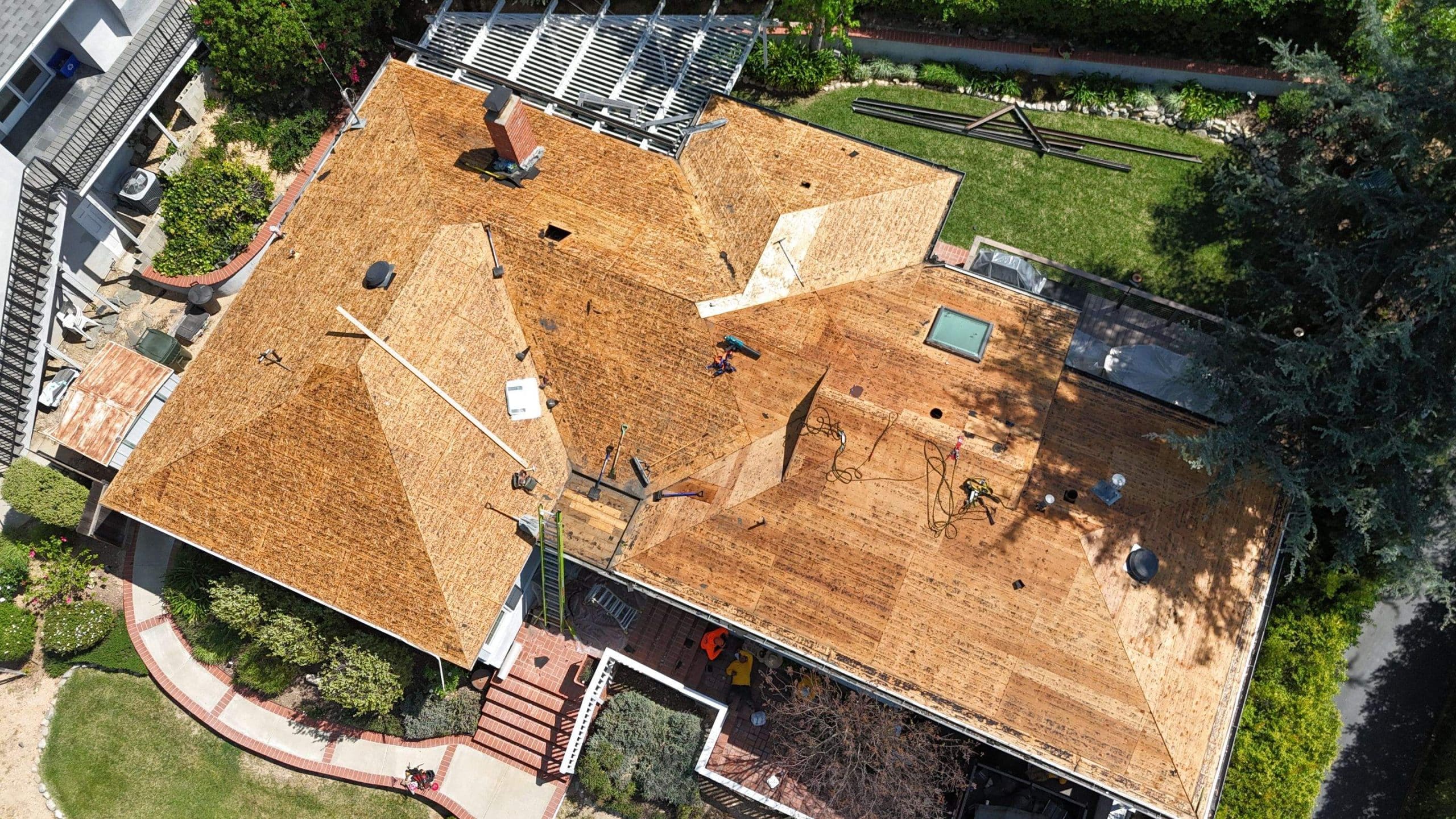
Roof deck failure doesn’t announce itself with obvious symptoms until problems become severe. A qualified roofing contractor in Van Nuys identifies several conditions that mandate sheathing replacement rather than simple overlay. Long-term water infiltration creates the most common damage pattern—when leaks persist undetected for months or years, moisture saturates plywood fibers, causing delamination where the wood layers separate and lose structural integrity. You’ll see this as sagging sections visible from inside the attic, dark staining on sheathing undersides, or spongy areas that compress when walked on during inspection.
Termite damage presents another significant concern in Van Nuys’s climate. Subterranean termites common throughout Los Angeles County target roof decking when moisture creates favorable conditions, leaving behind hollowed channels that compromise panel strength. Unlike water damage that typically concentrates around penetrations and valleys, termite damage can spread across multiple sheets in seemingly random patterns. Wind events also stress deck attachments—when high Santa Ana winds generate uplift forces, inadequately fastened sheathing can pull away from rafters, creating gaps and flex points that accelerate deterioration even if panels themselves remain structurally sound.
Age-related degradation affects Van Nuys homes differently based on construction era. Properties built in the 1960s and 1970s around neighborhoods like Van Nuys Civic Center and Chandler Estates often used lower-grade plywood or thinner panels (3/8-inch instead of modern 7/16-inch or 1/2-inch standards) that don’t meet current building codes. When reroofing these structures, bringing sheathing up to code becomes mandatory in many jurisdictions, adding unexpected expense to projects homeowners initially budgeted as cosmetic upgrades.
Cost Breakdown: How Contractors Price Roof Deck Replacement
Roof decking replacement follows two primary pricing models that roofing companies apply differently based on damage extent. Per-square-foot pricing typically ranges from three to seven dollars installed, varying with material choice, access difficulty, and labor rates in your specific Van Nuys neighborhood. This method works well for scattered damage where contractors replace isolated sheets rather than entire roof sections. For a standard 1,500-square-foot roof where 20% of decking requires replacement (300 square feet), expect material and labor costs between $900 and $2,100 for this portion alone.
Per-sheet pricing offers an alternative calculation favored when replacing multiple contiguous panels. Standard 4×8 plywood sheets (32 square feet each) cost between $40 and $80 installed depending on thickness and grade. CDX plywood—the construction-grade material most residential roofing contractors specify—falls mid-range, while higher-grade options with fewer knots and better moisture resistance push toward the upper limit. A complete deck replacement on that same 1,500-square-foot roof requires approximately 47 sheets, translating to installed costs between $1,880 and $3,760 for materials and basic installation.
These figures don’t include tear-off and disposal of damaged decking, which adds another layer of expense. Removing compromised sheathing requires careful work to avoid damaging rafters and underlying structure, typically adding $1-2 per square foot to demolition costs beyond standard roofing material removal. For budget-conscious Van Nuys residents where median household income sits around $62,000, understanding these cost layers before starting projects prevents financial surprises that derail timelines or force compromise on material quality.
OSB Versus Plywood: Material Price Differences
Material choice significantly impacts both immediate costs and long-term performance. Oriented Strand Board (OSB) costs 15-30% less than equivalent plywood—a 7/16-inch OSB panel typically runs $25-35 installed per sheet compared to $35-50 for comparable plywood. This price advantage makes OSB attractive for budget-focused projects, and modern manufacturing produces OSB with excellent structural properties that meet or exceed building codes when properly installed and protected from moisture.
However, plywood maintains important advantages that justify premium pricing in many Van Nuys applications. Plywood sheds water more effectively than OSB, an important consideration given that even brief exposure during installation can cause OSB edges to swell permanently. Plywood also holds fasteners more securely over decades, reducing nail pop issues that plague some OSB installations. For homes in Van Nuys’s higher-value neighborhoods or properties where owners plan long-term residence, plywood’s durability often outweighs initial savings from OSB alternatives.
The Hidden Deck Problem: Why Contractors Discover Damage During Tear-Off
One of the most frustrating aspects of roof deck replacement involves timing—many homeowners don’t learn they need new sheathing until contractors have already stripped off the old roofing materials. This isn’t necessarily contractor negligence; deck damage often remains completely hidden beneath intact shingles or tiles until removal exposes underlying deterioration. A roofing contractor conducting pre-project inspections can identify obvious issues like sagging or interior staining, but subtle delamination, concealed water pathways, and early-stage rot may only become apparent once surface materials come off.
This reality creates planning challenges. Reputable contractors include contingency allowances in estimates, noting that final costs depend on deck condition discovered during tear-off. Less scrupulous operators submit unrealistically low bids that don’t account for likely deck work, then present homeowners with substantial change orders once projects are underway and homes are vulnerable with roofs partially removed. For Van Nuys residents evaluating proposals, quotes that don’t mention potential deck replacement warrant skepticism—asking specifically how contractors handle unexpected sheathing damage separates professionals from opportunists.
Thermal imaging and moisture meters provide tools for more thorough pre-tear-off assessment. Advanced leak detection methods can identify moisture-saturated decking before removal begins, though these diagnostics add upfront costs that budget-conscious homeowners sometimes decline. The trade-off involves balancing inspection expenses against the risk of mid-project surprises—for properties with known leak history or age-related concerns, investing in comprehensive pre-work assessment often pays dividends in accurate budgeting and timeline planning.
Building Code Requirements: Van Nuys Sheathing Standards
Los Angeles County building codes establish minimum sheathing specifications that affect both new construction and replacement projects. Current standards require minimum 7/16-inch thickness for rafters spaced 24 inches on center, the most common residential framing configuration. For rafters spaced 16 inches (less common but present in some older Van Nuys construction), 3/8-inch sheathing technically meets code, though most contractors recommend 7/16-inch or 1/2-inch for improved performance regardless of spacing.
Attachment specifications matter equally. Modern codes require sheathing fastened with 8d nails spaced 6 inches along panel edges and 12 inches in the field (interior area). Wind-rated installations in exposed areas may mandate closer spacing or ring-shank nails for superior holding power. When replacing deck sections, contractors must bring new sheathing up to current code even if surrounding original material doesn’t meet these standards—you can’t install 3/8-inch panels on a home where codes now require 7/16-inch, even if that’s what the rest of the roof has.
H-clips—small metal connectors that support panel edges between rafters—represent another code consideration that affects installation cost and performance. These inexpensive components (typically under $1 each) prevent panel edges from flexing and creating visible ridges in finished roofing, but installing them adds labor time that some contractors skip on budget projects. For Van Nuys homes where property values justify quality installation, insisting on H-clips prevents aesthetic issues that compromise otherwise solid workmanship.
Spaced Plank Decking: The Pre-1980s Challenge
Van Nuys homes built before 1980 frequently feature spaced plank decking rather than continuous plywood sheathing—a construction method where 1×6 or 1×8 boards run perpendicular to rafters with gaps between each plank. This approach worked adequately with wood shake roofs common in that era, where thick shingles bridged gaps without issue. Modern roofing materials, however, perform poorly over spaced decking. Composition shingles sag into gaps creating visible lines, tiles lack adequate support, and modern underlayments can’t seal properly without continuous substrate.
Converting spaced plank decking to continuous sheathing adds substantial cost to reroofing projects but often proves unavoidable for quality installations. Contractors typically install plywood or OSB directly over existing planks rather than removing them, a process called overlayment that provides continuous substrate while preserving original structural elements. This approach requires 3/8-inch or 7/16-inch sheathing installed perpendicular to existing planks, adding approximately $2-3 per square foot to project costs—for a 1,500-square-foot roof, that’s $3,000-$4,500 in additional expense beyond standard reroofing.
Some contractors propose alternatives like installing skip sheathing (additional planks filling gaps) rather than full overlay, a less expensive option that still leaves small gaps unsuitable for modern materials. For Van Nuys homeowners where the high renter population means some readers manage rental properties, understanding this distinction prevents accepting inadequate solutions on investment properties where cutting corners compromises tenant safety and creates liability exposure.
Red Flags Suggesting Hidden Deck Problems
Several warning signs indicate potential deck damage before contractors begin tear-off, allowing more accurate budgeting and planning. Interior ceiling stains—even old discolored patches from supposedly resolved leaks—suggest moisture reached sheathing at some point, creating conditions for ongoing deterioration invisible from above or below. Water doesn’t always travel straight down; it can run along rafters for feet before dripping onto ceilings, meaning stains indicate deck damage in areas that might seem distant from visible symptoms.
Sagging roof lines visible from the street provide obvious red flags. When deck sections lose structural integrity, they create subtle depressions that become apparent when viewing the roof profile from ground level. Even minor sags (1-2 inches over 10-foot spans) indicate serious sheathing compromise requiring replacement. For Van Nuys properties in established neighborhoods like Lake Balboa Adjacent or Sherman Way Corridor, comparing your roofline to neighboring homes built in the same era helps identify abnormal sagging that warrants closer inspection.
Attic ventilation patterns offer another diagnostic clue. Homes with inadequate ventilation trap heat and moisture, accelerating deck deterioration even without active leaks. During attic inspections, look for condensation staining on sheathing undersides, a telltale sign that moisture accumulation threatens structural integrity. Dark discoloration, mold growth, or that characteristic musty odor all indicate conditions where deck replacement becomes likely during reroofing regardless of surface material condition.
The Insurance Claim Complication
Homeowners insurance creates another layer of complexity in deck replacement decisions. Most policies cover sudden damage from specific events (wind, hail, falling trees) but exclude deterioration from long-term neglect or lack of maintenance. When storms damage roofing materials, insurance typically pays for surface replacement but may dispute deck damage claims, arguing that underlying rot resulted from pre-existing maintenance failures rather than the covered event.
This distinction forces strategic decisions during claim processes. Contractors documenting damage for insurance adjusters must clearly differentiate storm-caused deck failure (split panels from fallen branches, fastener withdrawal from wind uplift) from pre-existing deterioration. For Van Nuys homeowners navigating claims, working with experienced roofing companies familiar with insurance documentation requirements increases approval likelihood and ensures proper compensation for legitimate storm damage versus homeowner-funded repairs for age-related issues.
| Deck Replacement Factor | OSB Sheathing | Plywood Sheathing |
|---|---|---|
| Material Cost (per sheet) | $25-35 installed | $35-50 installed |
| Moisture Resistance | Moderate (edges swell when wet) | Good (sheds water effectively) |
| Fastener Holding Power | Good initially, may loosen over decades | Excellent long-term retention |
| Best Application | Budget-focused projects, rentals | Premium installations, long-term homes |
| Typical Lifespan | 30-40 years when protected | 40-50+ years when protected |
How Deck Replacement Affects Total Reroofing Investment
Sheathing replacement transforms reroofing budgets from predictable to variable, with deck work potentially adding 20-50% to base project costs depending on damage extent. For a typical Van Nuys home with 1,500 square feet of roofing where composition shingle replacement runs approximately $6,000-9,000 for materials and labor, discovering that 40% of decking needs replacement adds another $1,800-4,200 to the total investment. These aren’t small adjustments—they represent budget impacts that strain finances for households managing the area’s $62,000 median income alongside $700,000 home values.
Project timelines extend proportionally with deck work scope. Replacing scattered sheets adds perhaps half a day to standard reroofing schedules, while complete deck replacement can double project duration from 2-3 days to 4-6 days for typical single-family homes. Extended timelines matter beyond inconvenience—they create additional weather exposure risk if rain threatens before completion, potentially requiring expensive emergency tarping and schedule adjustments that cascade through contractor commitments.
The budget impact varies dramatically based on damage patterns. Isolated damage concentrated around chimneys, skylights, or valleys where leaks typically originate costs far less than widespread deterioration requiring systematic replacement across entire roof planes. For Van Nuys homeowners planning projects, requesting detailed deck assessments—including attic inspections and moisture testing—before signing contracts provides data for realistic budgeting even if it delays project starts by days or weeks.
Making Informed Decisions: Planning Your Van Nuys Roof Deck Project
Successfully navigating roof deck replacement requires combining technical knowledge with practical planning strategies. Start by securing multiple detailed estimates that explicitly address deck replacement contingencies rather than vague “subject to inspection” clauses that leave cost ranges undefined. Request contractors specify their per-square-foot rates for deck work, material preferences (OSB versus plywood), and how they handle mid-project discoveries of additional damage beyond initial assessments.
Timing decisions around deck replacement differs from standard reroofing considerations. While waiting until off-season for better contractor pricing makes sense for surface work, delaying projects when deck damage exists risks progressive deterioration that increases eventual replacement costs. Water-damaged sheathing doesn’t improve with time—it worsens, spreading to adjacent panels and potentially damaging rafters and interior finishes. For Van Nuys homes where active leaks suggest deck compromise, prompt action saves money despite potentially higher peak-season labor rates.
Financing considerations become critical when deck replacement surfaces mid-project. Homeowners who budgeted for basic reroofing suddenly face substantially higher costs, often requiring quick decisions about payment sources while contractors wait for approval to proceed. Establishing home equity lines of credit or contractor financing arrangements before projects begin—even if you don’t anticipate needing them—provides financial flexibility that prevents desperate decisions or work stoppages when unexpected deck damage appears.
Whether you’re managing a rental property in Van Nuys’s high-renter market or maintaining your own residence, understanding roof deck replacement costs transforms you from passive recipient of contractor pronouncements into informed participant in decision-making processes. The structural deck supporting your roof deserves the same careful attention as visible shingles or tiles—it’s the foundation everything else depends on, and cutting corners on this hidden component creates problems that persist for decades.
For expert assessment of your Van Nuys roof deck condition and transparent pricing on replacement options, contact Roof Replacement Inc at (213) 364-3979. Our experienced team provides thorough inspections that identify deck issues before tear-off begins, detailed estimates that account for likely scenarios, and quality workmanship that ensures your structural investment performs for decades. We serve homeowners throughout Van Nuys’s 91401, 91405, 91406, and 91411 ZIP codes, plus neighboring communities including Panorama City and Encino, bringing local expertise to every project we undertake.
Related Posts



What Our Clients Say

Roof Replacement Inc. offers professional, high-quality work, guaranteed (call for details); ensuring all clients projects meet all code and design requirements. We are dedicated to exceptional customer service and will strive to ensure you with the highest quality roofing services. Roof Replacement Inc. offers lifetime warranty (call for details) on all of our workmanship to ensure the quality of our work. With over four decades of experience and success within the roofing and construction industry, Roof Replacement Inc. has grown and developed in all areas of roofing construction, including roof inspections. As a leading residential and commercial roofing company in LA, we have hundreds of references from previous clients, so rest assured, that your roofing job will be done right the first time. Replacing an old roof can help add curb appeal and will increase the perceived value of your home. First impressions are vital when selling your home, especially when your roof takes up more than half of the exterior of your residence or business. Not only is the return of investment on a new roof attractive for potential buyers, but can be as beneficial as remodeling the kitchen or bathrooms within your residence.

