

Why Northridge’s Architectural Features Make Leak Detection Uniquely Challenging
Northridge homes—particularly in neighborhoods like Sherwood Forest and the CSUN Area—present distinct water intrusion challenges due to their 1950s-1980s construction patterns. Many properties feature complex roof valleys, multiple elevation changes, and original plumbing vent penetrations that have aged beyond their design life. Unlike newer construction, these homes often incorporate concealed gutters, built-in planters, and decorative eaves that create moisture traps invisible from ground level. The median $850,000 home value here means detecting hidden leaks early becomes a substantial investment protection issue, not merely a maintenance task.

📋 In This Guide
What makes roof leak detection in Northridge different from simple visual inspection is the investigation methodology. You’re not looking for water where you see stains—you’re tracking moisture backward through your home’s structure to identify the actual entry point, which may be fifteen feet away from visible damage. Professional Roof Repair in Northridge specialists understand this forensic approach, combining physical evidence with building science to map how water travels through roof assemblies, attics, and wall cavities before finally appearing on your ceiling.
Sequential Moisture Investigation: Following Water’s Hidden Journey
Water entering through roof penetrations rarely drops straight down. Instead, it follows structural pathways—traveling along rafter tops, running down insulation batts, pooling on vapor barriers, then migrating laterally until gravity forces it through the weakest ceiling penetration point. In Northridge’s Porter Ranch Adjacent properties, where many homes feature cathedral ceilings and complex framing, water can travel twenty feet horizontally before creating visible damage.
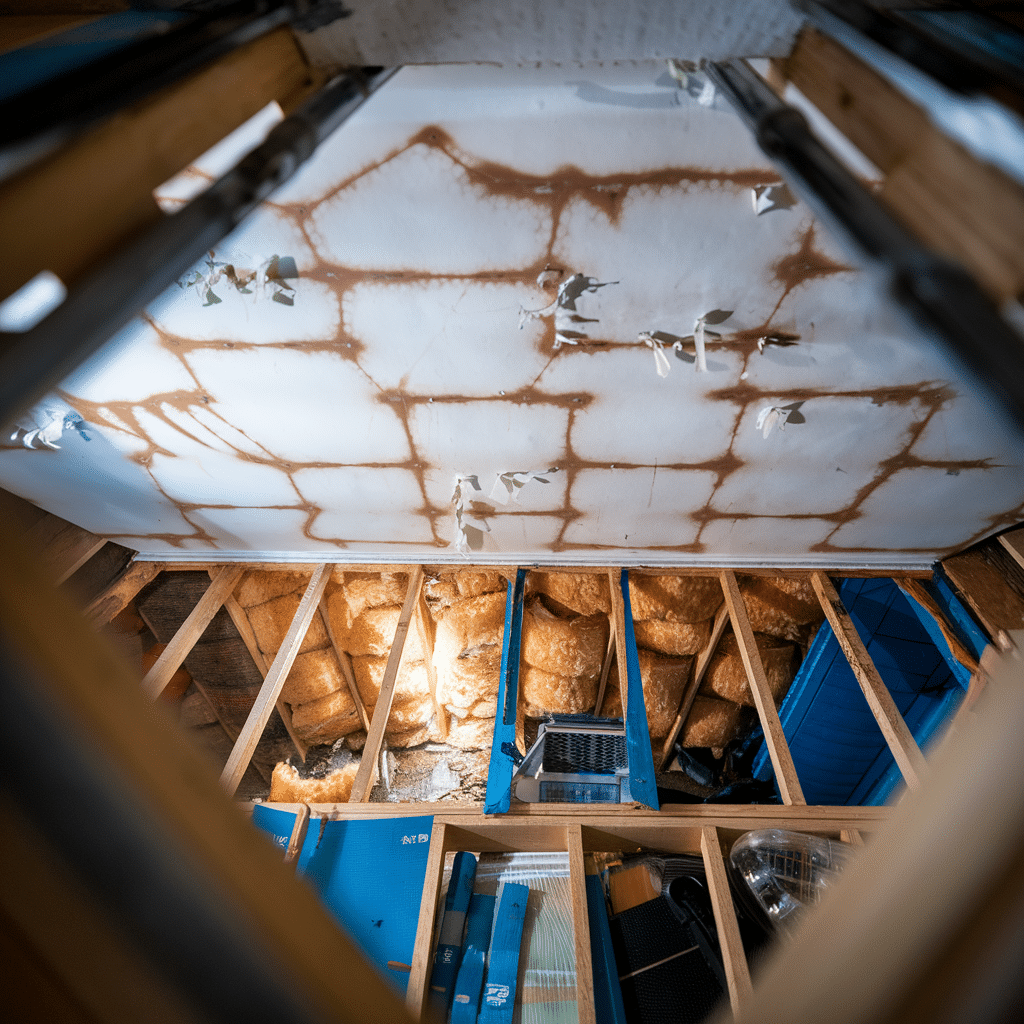
Begin your investigation at the visible stain, then work backward systematically. Remove insulation in the affected bay to expose the actual wood framing—you’re looking for dark discoloration, grain raising, or softened wood texture indicating chronic moisture exposure. Use a flashlight at acute angles across rafter surfaces; fresh water leaves a distinctive sheen that indicates active leaking. Follow the moisture trail upward toward the roof deck, noting whether the pattern converges toward a single penetration or spreads across multiple framing members.
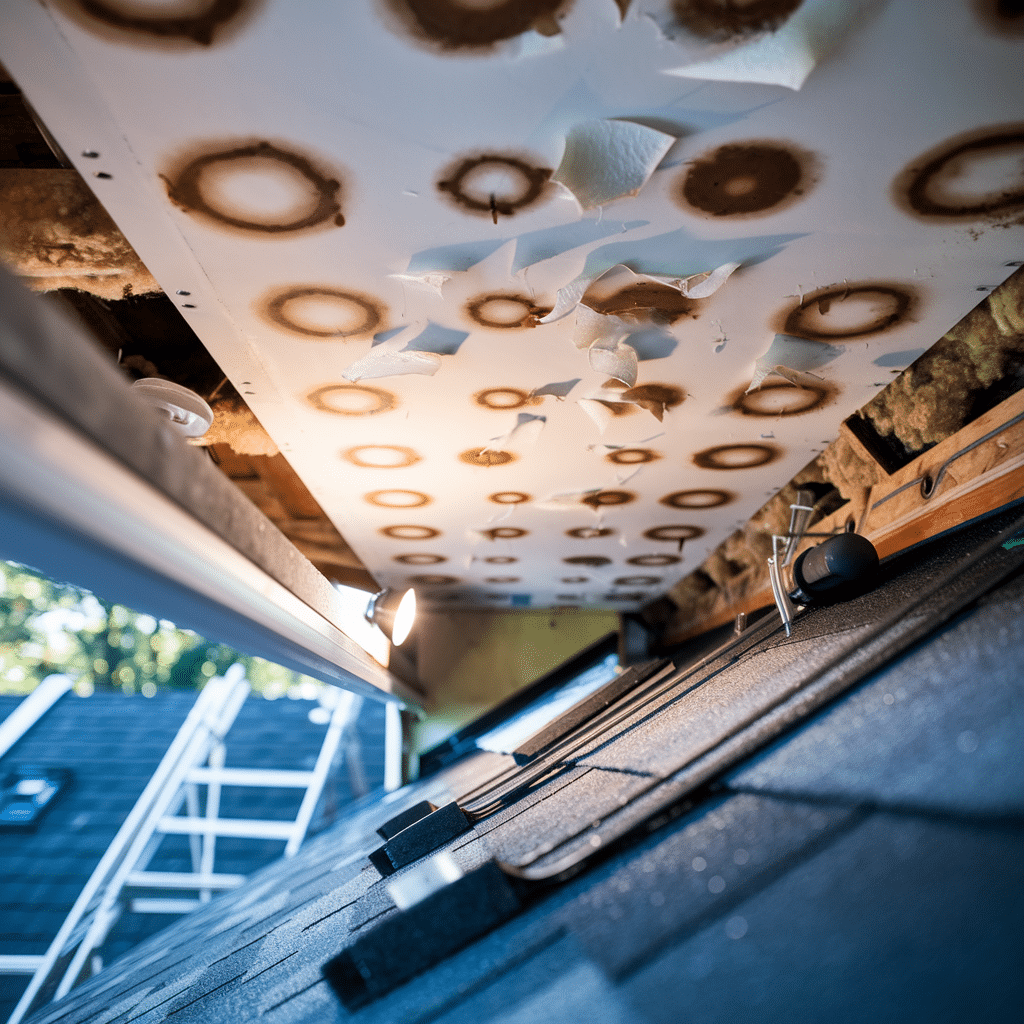
Document what you find with dated photographs. Stains that appear fuzzy or have concentric rings indicate old damage that has dried. Sharp-edged, dark stains with surrounding wet wood suggest ongoing problems requiring immediate attention. This documentation becomes crucial when working with contractors and insurance adjusters—it establishes the damage timeline and helps distinguish between sudden storm damage and chronic neglect issues that may affect coverage.
Critical Inspection Zones Where Northridge Homes Commonly Fail
Certain architectural features dominate leak investigations in Northridge properties. Valley flashing—where two roof planes intersect—represents the highest-risk zone because these areas concentrate tremendous water volume during the region’s occasional heavy rain events. Original valley installations often used woven shingles or metal flashing that has corroded or separated over decades. From inside your attic, inspect along the valley line for water-stained sheathing, rust streaks on metal, or daylight visible through gaps.
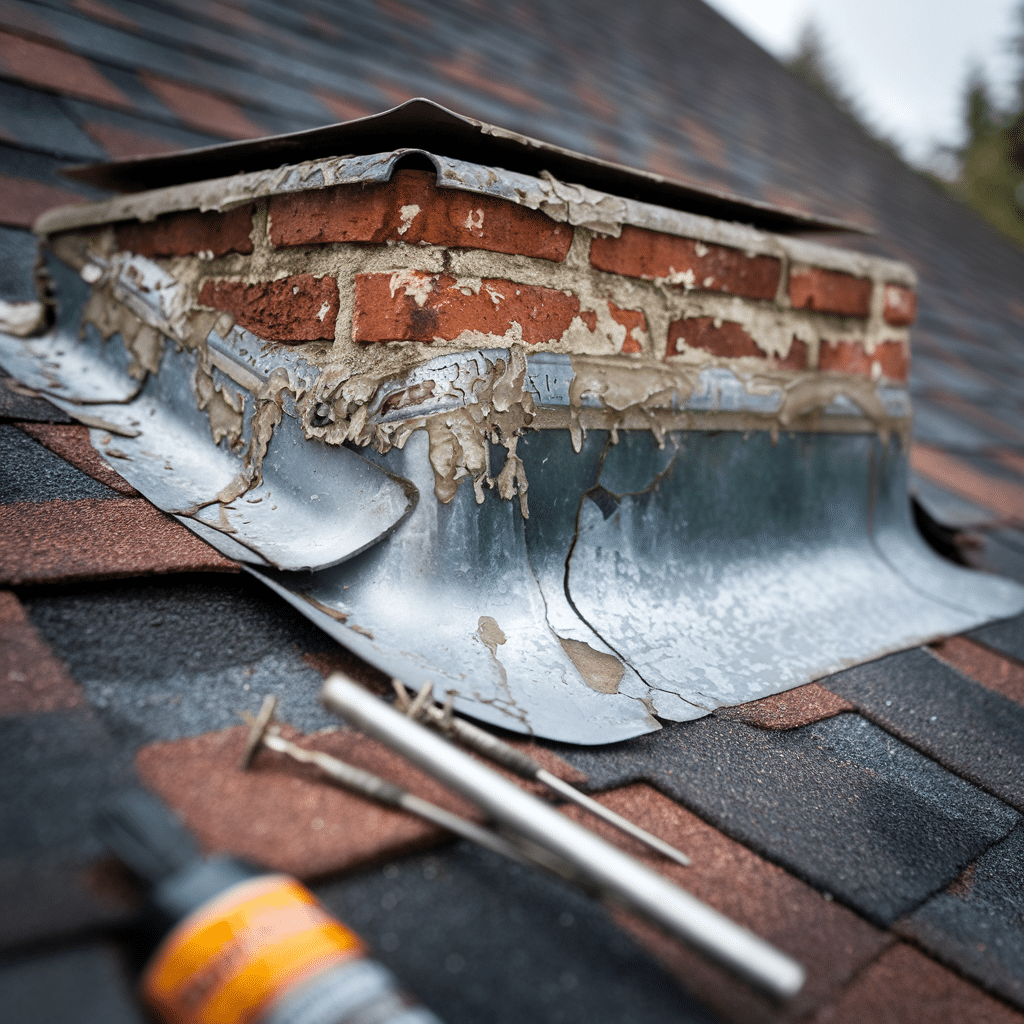
Chimney-to-roof transitions create the second most common failure point. The counter-flashing—metal pieces embedded in the chimney masonry—often separates as mortar joints deteriorate. This creates a hidden channel where water enters behind the visible flashing and runs down the chimney exterior before finding entry into your home’s framing. Check for white efflorescence (mineral deposits) on attic-side chimney surfaces, which indicates water has been wicking through masonry for an extended period.
Plumbing vent boots—the rubber or lead collars sealing pipe penetrations—typically fail after 15-20 years in Southern California’s UV-intense climate. These failures rarely show obvious external cracking; instead, the rubber loses flexibility and separates from the pipe at the base collar where it’s invisible from above. From your attic, you can often see daylight around failed vent boots or find water staining in a perfect circle around the pipe penetration point. Professional Roofing services in Northridge include systematic vent boot inspection because these small failures can cause outsized structural damage if left unaddressed.
Advanced Detection Methods: When Visual Inspection Reaches Its Limits
Thermal imaging cameras detect temperature differentials as small as 0.1 degrees Fahrenheit, making them invaluable for identifying moisture hidden beneath insulation or inside wall cavities. Wet building materials retain heat differently than dry materials—during evening hours when ambient temperatures drop, moisture-laden areas appear warmer on thermal images. Professional inspectors conducting roof leak detection in Northridge use calibrated thermal cameras from attic spaces, scanning systematically across entire roof decks to identify anomalous temperature patterns that indicate concealed moisture.
Moisture meters provide quantitative data that thermal imaging cannot. Pin-type meters measure electrical resistance between two probes inserted into wood—wet wood conducts electricity more readily than dry wood, producing higher meter readings. Readings above 20% indicate active moisture problems; readings above 28% suggest water saturation that will inevitably lead to wood decay. Non-invasive meters use radio frequency signals to detect moisture depth without surface penetration, making them ideal for testing across large areas quickly.
However, these tools require training to interpret correctly. Wood species, temperature, and probe depth all affect readings. A reading of 18% might indicate active problems in Douglas Fir framing but could represent normal equilibrium moisture content in certain tropical hardwoods. DIY moisture meters (available at hardware stores for $30-50) provide useful screening data but lack the calibration and sensor quality of professional equipment. When investigating potential damage on an $850,000 Northridge property, the $200-400 cost of professional inspection with calibrated equipment represents sound risk management rather than unnecessary expense.
Weather Timing Strategy: When to Conduct Your Investigation
Northridge experiences approximately 15 inches of annual rainfall concentrated primarily between November and March. This precipitation pattern creates distinct detection windows. Active leaks become most evident within 24-48 hours following significant rain events—moisture hasn’t yet dried from structural components, stains appear fresh and dark, and you may even find standing water in attic spaces or wall cavities. Schedule your investigation during this window for maximum evidence visibility.
Conversely, mid-summer through early fall represents ideal timing for detecting old damage patterns without the confounding factor of fresh water. During July through October, any moisture present in framing represents either chronic ongoing leaks from sources other than rain (such as HVAC condensation lines or attic ventilation failures) or wood that never fully dried from previous winter storms. Summer investigations help distinguish between transient surface wetting and deep structural saturation that indicates long-term problems.
For properties near the Roofing in Granada Hills border or in elevated Northridge neighborhoods, microclimate variations can affect moisture behavior significantly. Southern-exposure roof sections dry faster but experience more UV degradation of waterproofing materials. Northern sections retain moisture longer but show less thermal cycling stress. Understanding these patterns helps target your investigation toward the most vulnerable areas based on specific property orientation and local topography.
When to Transition From Investigation to Professional Intervention
Three conditions should immediately trigger professional involvement. First, if you discover structural wood that compresses under finger pressure, shows fuzzy surface texture, or breaks apart easily, you’ve found advanced decay that extends beyond simple leak repair into structural restoration territory. Second, if moisture meters consistently show readings above 28% across multiple locations, you’re dealing with systemic water intrusion that requires comprehensive diagnosis rather than isolated patching. Third, if you smell musty odors in attic or wall spaces even without visible water staining, hidden mold growth has likely established itself on concealed surfaces.
The challenge many Northridge homeowners face involves deciding whether to attempt temporary repairs while investigating further or commit to immediate comprehensive intervention. A useful framework: if the affected area measures less than four square feet, the water source appears obvious (such as a clearly cracked vent boot), and wood shows only surface staining without structural compromise, targeted repair may prove sufficient. If the damage extends across multiple roof bays, the water source remains unclear despite investigation, or structural members show any flexibility or decay, comprehensive professional assessment becomes necessary before attempting repairs.
Contact Roof Replacement Inc at (213) 319-5884 when your investigation reveals conditions beyond your expertise or comfort level. Our Northridge team combines decades of experience with professional detection equipment to identify water intrusion sources that homeowner investigations typically miss. We provide detailed documentation suitable for insurance claims, clear remediation recommendations with cost ranges appropriate to Northridge’s middle-income market ($78,000 median household income), and repair approaches that address root causes rather than simply covering symptoms. Early professional intervention on an $850,000 property investment prevents the exponential damage progression that turns $2,000 repairs into $25,000 restoration projects.
Preventive Monitoring: Establishing a Detection Routine
Effective leak detection in Northridge isn’t a one-time investigation—it’s an ongoing monitoring protocol. Establish a twice-yearly inspection routine: once in early December before the heaviest winter rains arrive, and once in late April after spring storms conclude. Each inspection should follow the same route through your attic space, photographing the same reference points from consistent angles. This creates a visual timeline that makes subtle changes obvious even when individual inspections reveal nothing dramatic.
Develop familiarity with your home’s normal moisture patterns. Most attics show slight moisture variation between seasons due to temperature cycling and ventilation efficiency changes. What matters isn’t absolute moisture readings but rather deviations from your property’s established baseline. A reading of 14% might indicate problems on a home that normally runs at 8%, while representing normal conditions on a property that consistently measures 12-16%.
Properties in the Sherwood Forest neighborhood, with mature tree canopy coverage, often show higher baseline attic moisture than properties in newer developments near Northridge Fashion Center with minimal landscaping. Neither situation represents inherent problems—what matters is recognizing when readings deviate significantly from your property’s historical pattern. Professional Roofing in Van Nuys and surrounding areas emphasizes this baseline establishment approach because it dramatically improves early detection accuracy compared to one-time inspections evaluated against generic moisture standards.

Marcus Rivera has spent 14 years in the field as a roofing estimator and site supervisor across Southern California, inspecting and overseeing hundreds of residential and commercial roof replacements throughout the San Fernando Valley and Ventura County. He holds a HAAG-certified roof inspector credential and specializes in helping homeowners understand the real scope of damage before committing to a replacement. At Roof Replacement Inc., Marcus leads the estimation team and serves as the go-to resource for complex re-roofing projects involving tile, shingle, and low-slope systems.
❓ Frequently Asked Questions
How far can water travel from a roof leak before showing ceiling damage?
Water commonly travels 10-20 feet horizontally along rafters, insulation, or vapor barriers before gravity forces it through ceiling penetrations. In homes with cathedral ceilings or complex framing, moisture can migrate even further, making the visible stain location significantly different from the actual roof entry point.
Can thermal imaging cameras detect roof leaks through insulation?
Yes, professional-grade thermal cameras detect temperature differentials caused by moisture even beneath insulation layers. Wet building materials retain and release heat differently than dry materials, creating temperature signatures visible on thermal images during evening hours when ambient temperatures drop and moisture-laden areas appear warmer.
What moisture meter reading indicates I need immediate roof repair?
Consistent readings above 20% indicate active moisture problems requiring attention, while readings above 28% suggest water saturation that will cause wood decay if not addressed. However, wood species and temperature affect readings, so professional interpretation with calibrated equipment provides more reliable diagnosis than consumer-grade meters.
Should I schedule roof leak detection before or after rain in Northridge?
Schedule investigations 24-48 hours after significant rain for maximum evidence visibility when active leaks remain wet and stains appear fresh. Alternatively, mid-summer through early fall inspections reveal old damage patterns without fresh water, helping distinguish chronic problems from transient surface wetting. Contact Roof Replacement Inc at (213) 319-5884 for professional timing recommendations based on your specific situation.
🏘️ Same Topic in Nearby Cities
Related Posts



What Our Clients Say

Roof Replacement Inc. offers professional, high-quality work, guaranteed (call for details); ensuring all clients projects meet all code and design requirements. We are dedicated to exceptional customer service and will strive to ensure you with the highest quality roofing services. Roof Replacement Inc. offers lifetime warranty (call for details) on all of our workmanship to ensure the quality of our work. With over four decades of experience and success within the roofing and construction industry, Roof Replacement Inc. has grown and developed in all areas of roofing construction, including roof inspections. As a leading residential and commercial roofing company in LA, we have hundreds of references from previous clients, so rest assured, that your roofing job will be done right the first time. Replacing an old roof can help add curb appeal and will increase the perceived value of your home. First impressions are vital when selling your home, especially when your roof takes up more than half of the exterior of your residence or business. Not only is the return of investment on a new roof attractive for potential buyers, but can be as beneficial as remodeling the kitchen or bathrooms within your residence.
Marcus Rivera has spent 14 years in the field as a roofing estimator and site supervisor across Southern California, inspecting and overseeing hundreds of residential and commercial roof replacements throughout the San Fernando Valley and Ventura County. He holds a HAAG-certified roof inspector credential and specializes in helping homeowners understand the real scope of damage before committing to a replacement. At Roof Replacement Inc., Marcus leads the estimation team and serves as the go-to resource for complex re-roofing projects involving tile, shingle, and low-slope systems.


